How to Teach Your Child Letters at Home: A Simple Method for Ages 3–6
By Akshay · 1 Nov 2026 · 6 min read
Short answer: the easiest way to teach letters at home is 15–20 minutes a day and one new letter a day. For each letter, first say its sound, then show a picture of something that starts with it (A for apple), then let your child colour the letter, and finally have them trace and write it. Before each new letter, revise the last two. The same method works for English letters, the Hindi varnamala or Marathi mulakshare.
Below is the full method: when to start, the order, a daily plan, games that help, common mistakes, and a two-week start.
Every child learns at their own pace. Some recognise letters at 3, others at 5. Don't compare, and don't force it.
When to start
Most children start showing interest in letters between 3 and 4, and begin writing them between 4 and 6. Before you start, check that your child:
- names things they see in pictures
- can hold a crayon or a thick pencil and draw lines
- can sit with one activity for 10–15 minutes
If pencil grip isn't there yet, start with line practice first: straight lines, waves, zig-zags and circles. It makes letters much easier later.
Which order to teach in
- English: many parents start with A to Z in order, because that is what children see at school. Some teachers prefer simple-shaped letters first (like l, o, c), which is also fine at home.
- Hindi: first the vowels (स्वर, अ to अः), then the consonants (व्यंजन, क to ज्ञ), the usual school order.
- Marathi: the same idea: स्वर first, then व्यंजन.
If your child gets stuck on a letter, move on and come back to it a few days later. What matters most is that learning stays fun.
Four steps for each letter
- Hear and say: say the letter's sound clearly, "A... apple". Ask your child to repeat it three times.
- Link it to a picture: show something that starts with the letter: A for apple, B for ball, C for cat. A real object at home is even better.
- Colour it: let your child colour a big outline of the letter and its picture. While colouring, they look carefully at the letter's shape.
- Make it: first with a finger in the air or in a plate of sand, rice or flour, then by tracing a light letter with a pencil, and finally on their own.
A 15–20 minute daily plan
- 2 minutes: revise yesterday's and the day before's letters ("Which letter is this? What starts with it?")
- 5 minutes: today's new letter: sound and picture
- 5–8 minutes: colour the letter and trace it with a pencil
- 3 minutes: a short game (see below)
- At the end: praise, and a star on the chart
One day a week, teach no new letter; just play games with that week's letters.
Eight games that help letters stick
- Letter hunt: circle today's letter on a newspaper page.
- Sound basket: collect things at home that start with the letter: for B, a ball, a banana, a bottle.
- Dough letters: shape letters out of chapati dough or clay.
- Sand or rice tray: draw a letter with a finger, shake the tray, draw it again.
- Jump and say: chalk three letters on the floor; jump on the one you hear.
- Hidden letters: hide letter cards around the room and find them.
- First sound: "What is the first letter of mango?"
- Child as teacher: let your child teach you the letters. Children love this.
Common mistakes to avoid
- Too many letters in a day: one new letter a day is enough.
- Only reciting: singing "A, B, C" is fine, but linking each letter to a picture and a sound works better.
- Correcting every mistake: a wobbly letter is still a first attempt. Praise the effort.
- Joining or matras too early: let single letters settle first; Hindi and Marathi matras (का, कि, की) come later.
- Learning only on a phone: some videos are fine, but colouring and writing on paper train both the hand and the eye.
The first two weeks (English example)
- Days 1–3: line practice: straight lines, waves, zig-zags, circles
- Day 4: A (apple)
- Day 5: B (ball)
- Day 6: C (cat)
- Day 7: revision and games only
- Day 8: D (dog)
- Day 9: E (egg)
- Day 10: F (fish)
- Day 11: G (grapes)
- Day 12: H (hat)
- Day 13: I (ice cream)
- Day 14: revision, games and a small "well done" celebration
Then carry on the same way with J to Z. For Hindi, the same plan works with अ (अनार), आ (आम), इ (इमली) and so on; see our Hindi guide to teaching the varnamala.
Frequently asked questions
What is the right age to start teaching letters?
Most children show interest in recognising letters between 3 and 4 and start writing between 4 and 6. More important than age is that your child recognises pictures, can hold a pencil and can sit for a few minutes.
How long does it take to learn all the letters?
At one letter a day with one revision day a week, English A to Z takes about 4–5 weeks. Every child's pace is different, so don't rush.
Should I teach capital or small letters first?
Many parents and schools teach capital and small letters together (Aa, Bb), because children see both in books. If your child finds it hard, start with capitals, which have simpler shapes, and add small letters a little later.
My child forgets letters. What should I do?
That is completely normal. Start each day by revising the last two letters, and keep one day a week only for games. Scolding makes children avoid learning.
Can my child learn English and Hindi letters together?
Yes. Many Indian children learn two scripts side by side. Just don't introduce new letters of both on the same day: for example A one day and अ the next.
What next
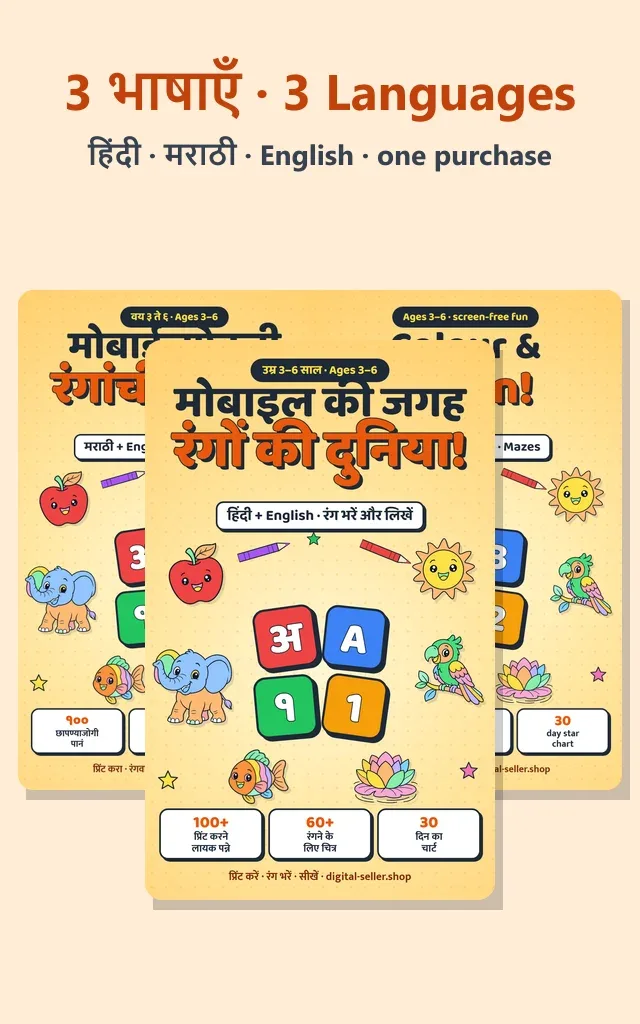
If you want ready pages for every letter, see our Colour & Learn activity book: English A–Z with a picture to colour for each letter, tracing and writing lines, numbers 1–20, mazes and a 30-day star chart. It also comes with Hindi and Marathi editions in the same purchase, and you can see a free sample first.
If your child keeps asking for the phone instead, read How much screen time is okay for kids? and 20 screen-free games for kids at home.