20 Screen-Free Games for Kids at Home: No Cost, Ages 2 to 8
By Akshay · 1 Nov 2026 · 5 min read
Short answer: you don't need expensive toys to keep a child away from the phone. Pillows, steel boxes, dough, chalk, leaves and a sheet of paper are enough for dozens of games. Below are 20 of them, grouped by situation: quick 5-minute games, indoors, in the kitchen, outdoors, before bed and while travelling. Each one says what you need and which age it suits.
The most important tip: keep the games planned in advance. Saying "no" to the phone is easy only when you have something fun ready to offer right away.
Quick 5-minute games
Good for when you are cooking or on a call: no preparation needed.
- 1. Guess the sound (3+): your child closes their eyes. Tap a glass with a spoon, knock on the door, crumple paper. They guess what it was.
- 2. Colour hunt (2+): "Bring me 5 red things from this room." Then yellow, then blue.
- 3. Statue (3+): play music or clap while your child dances. When it stops, they freeze like a statue.
- 4. Simon says (4+): do the action only when you hear "Simon says": "Simon says touch your nose."
Indoors
- 5. Pillow and bedsheet tent (2+): a bedsheet over two chairs, pillows inside. Then a story, a snack or a book in the tent.
- 6. Box band (2+): steel boxes, bowls and spoons. You play a rhythm; your child copies it.
- 7. Tallest tower (2+): build the tallest tower from blocks or empty boxes, then knock it down.
- 8. Hot and cold (3+): hide a toy. Say "hot" when your child gets close and "cold" when they move away.
- 9. Colouring and letters (3+): colouring pages, join-the-dots pictures, or tracing letters. This can also be the time to learn English, Hindi or Marathi letters.
Helping in the kitchen
Children love doing grown-up jobs. Always with an adult, and away from knives and the stove.
- 10. Shelling peas (3+): great practice for small fingers, and counting too: "How many peas did you get?"
- 11. Dough shapes (2+): give a ball of chapati dough. Let them make snakes, balls, letters or animals.
- 12. Setting the table (4+): "One bowl and one spoon on every plate." Counting and responsibility together.
- 13. Name the fruit and vegetable (2+): take things out of the bag one by one and talk about name, colour, shape and taste.
Outdoors, in the yard or on the balcony
- 14. Chalk drawings (3+): pictures, letters or a hopscotch grid on the ground.
- 15. Leaf and stone collection (2+): line them up from small to big, group them by colour, make leaf prints.
- 16. Shadow tag (3+): in the sun, try to step on each other's shadow.
Before bed (calm games)
Switch screens off at least an hour before sleep and use that time for calm games.
- 17. Hand-shadow animals (3+): with a torch or lamp, make a dog, a bird or a deer on the wall. Your child guesses which.
- 18. My day (3+): your child tells three things from the day in order: first, then, last.
While travelling (auto, bus, train, car)
- 19. Count the vehicles (3+): "How many red cars did you see?" or "How many autos?"
- 20. I spy (4+): "I spy with my little eye something green..." Everyone else guesses.
How to make it a daily habit
- Keep a "play basket": chalk, crayons, colouring pages, blocks and a torch. When your child is bored, open the basket, not the phone.
- A fixed playtime every day: for example 4:30 to 5 in the evening. When children know what comes next, there are fewer tantrums.
- Play along at first: if you play for the first 5 minutes, your child often carries on alone.
- Let them be a little bored: don't hand over the phone at the first "I'm bored". Children often find their own game soon after.
- Don't use the screen as a reward: "Finish the game, then you get the phone" makes the phone feel even more precious.
Frequently asked questions
My child cries for the phone and won't play. What should I do?
This is normal for the first 3–4 days. Don't snatch the phone suddenly: say "five more minutes" and set a timer, and as soon as the screen goes off, start a game your child enjoys. Play along yourself for the first few days.
Which games are best for a 2-year-old?
Colour hunt, box band, pillow tent, dough shapes, leaf collection and naming fruits and vegetables are easy for 2-year-olds. Keep small objects that could go in the mouth away, and stay with your child all the time.
How can I keep my child busy without spending money?
With what you already have: steel boxes, pillows, a bedsheet, dough, old newspapers, leaves and chalk. Most games in this article cost nothing at all.
How much playtime does a child need in a day?
According to the WHO, children aged 3–4 need at least 3 hours of moving and playing in a day, including at least 1 hour of energetic play. It can be spread across the day in short bursts.
What can we play when it's raining or too hot outside?
The indoor games: tent, statue, hot and cold, box band, Simon says and colouring. Statue and Simon says get the body moving too.
What next
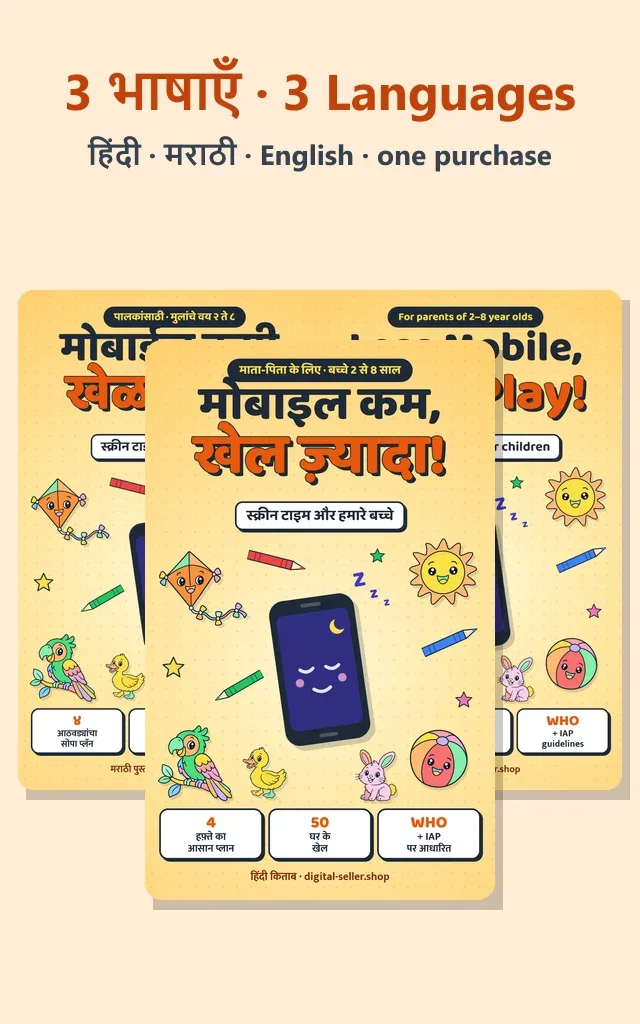
50 home activities, a week-by-week plan to cut screen time and what to say during tantrums are all in our short book Less Mobile, More Play, in English, Hindi and Marathi. For ready colouring and letter-tracing pages for 20–30 minutes a day, see the Colour & Learn activity book.
Also read: